Autonomous agents with memory and context — patent filed with the USPTO

Hal-AI Agentic

The platform for agents that hold on to context

Hal-AI Agentic is the core that lets an autonomous agent actually do the work: short- and long-term memory, retrieval of the context that matters, tools wired into your systems, and a real decision at every turn. The memory framework has been on file as a patent with the USPTO since 2025.

The same brain on WhatsApp, on webchat and on the phone.

Anatomy of a Hal-AI agent

Memory

Vectorized conversation history, stable facts, customer traits and a sense of time.

Knowledge

A Knowledge Vault per agent: documents, text and images, all indexed.

Tools

REST APIs from your ERP, MCP servers, website reading, search and handoff to a human.

Personality

Name, voice, tone and boundaries set in writing — not in a decision tree.

The starting point

A designed flow breaks on the first sentence that leaves the script

A flow-based chatbot only knows what someone drew for it. Every exception becomes another node, every process change becomes a rebuild of the tree — and the customer who phrases things their own way gets sent back to the main menu.

Chatbot built on a designed flow

  • Every question you anticipate needs its own node in the diagram.
  • Step off the script and the customer lands back at the opening menu.
  • Starts from zero in every conversation: no idea what was already handled.
  • Process changed? Someone has to redraw and republish the tree.
  • Checking a company system means bolting a detour onto the flow.
  • Every new channel is another flow to maintain.

A Hal-AI Agentic agent

  • Gets personality, knowledge and tools — then decides at every turn.
  • Understands the off-script request because there is no script.
  • Picks up weeks later with the facts that matter about that customer.
  • Process changed? You adjust context and tools, not a diagram.
  • Your ERP APIs are tools the agent uses, not exceptions to handle.
  • The same agent answers on WhatsApp, on your site and on the phone.

This is not a chatbot with a flow. It is an operational agent trained to do the work.

An AI humanoid reaching out to touch a glowing Hal-AI chip seated on a circuit board, an original Hal-AI illustration for the patented memory framework
USPTO · 2025

The memory that keeps the thread of the conversation

Patent Autonomous Agent Memory Framework Inspired by Human Cognition

In 2025, Hal-AI filed this memory and context framework with the USPTO. In plain terms, it gives an agent two kinds of memory and a sense of when to use each: short-term memory for what is happening right now, in this conversation, and long-term memory for what is known about that customer and about the company over time.

On top of that sits retrieval. Storing everything is easy; bringing back only the context that matters for the current turn — without flooding the agent's reasoning with history it does not need — is the hard part. And then task continuity: knowing what has been done, what is still open and what no longer makes sense to do, including across conversations separated by days.

That is why it is ours alone to offer. It is the line between an agent and an automation: an automation starts over at every message, while an agent with memory keeps the thread, picks the task back up where it stopped and stops asking for what it already has.

Companies in logistics, aviation, healthcare and banking already run the framework in production.

Internal details of the framework are not disclosed. What is described here is the problem it solves.

Long-term and episodic memory

The agent doesn't start over with every conversation

Conversation history is vectorized through embeddings, and a background worker pulls stable facts and customer traits out of it. That is episodic memory: what happened, with whom and when.

  • Stable facts — what stays true after the conversation ends.
  • Customer traits — preferences, tone of voice and order history.
  • A sense of mood and time — the difference between "yesterday" and "three months ago" changes the answer.
  • Retrieval by relevance — the agent brings back the passage that matters, not the entire history.
  • The same technology on every channel — channel agents, voice service and Squads all share the same mechanism.
  • Manager control — long-term memory can be switched on or off per agent, and the Conversation Memory screen shows what is stored per channel and lets you clear it.
Hal-AI agent online
Good afternoon. My order arrived one box short.2:02 PM
Good afternoon, Renata. I found order 4471, delivered this morning. I'm opening a case for the missing box now.2:02 PM
I'd rather have the replacement sent to the branch address, not headquarters.2:04 PM
Noted. Replacement logged for the branch. I'll let you know here as soon as it leaves the warehouse.2:04 PM

Continuity across conversations weeks apart.

What the agent stores is not hidden away. The Conversation Memory screen opens the memory channel by channel: the stable facts the background worker extracted about that contact, the traits observed across conversations and the date of the last contact. Every fact carries the conversation it came from and the date it was recorded, and the manager can erase everything stored about a person with a single command.

Hal-AI · Conversation Memory By channel
Conversation Memory What the agent stores about each contact, channel by channel.
Last 90 days
Contact Renata M. — purchasing Memory on
Last contact 3 days ago · WhatsApp 14 conversations since March A sense of time is part of the memory: the agent treats "yesterday" and "three months ago" differently when picking the subject back up.
Stable facts stored about the contact
Stable factSourceRecordedState
Replacements always go to the branch address, never headquarters conversation 4471 Mar 12 confirmed
Recurring order of 12 boxes a month conversation 4471 May 2 confirmed
Replies best in the early morning 14 conversations Jun 18 observed
Has had one case of a missing box conversation 4471 Mar 12 attention
Changed billing departments in July conversation 4620 Jul 29 to reconfirm
Warm tonehigh Prefers directnessmedium Sensitive to deadlineslow
Clear this contact's memory Erases 5 facts and 3 traits · the conversation history is not affected

Conversation Memory: channels on the left, stable facts with source and date in the middle, observed traits below and the clear command always in sight.

What you're looking at

On the left, the channels the operation runs on, each showing how many contacts already have memory stored. In the middle, the contact record and the table of stable facts: every row carries the fact, the conversation it came from, the date it was recorded and its state — confirmed, observed or up for reconfirmation. Below that, the traits observed across conversations, and the strip that spells out exactly what the clear button erases: the facts and the traits, not the service history.

The advantage

Nobody has to keep a spreadsheet of customer preferences or hand off context at shift change: what was already said comes back on its own in the next conversation instead of being asked again. Because every fact shows its source conversation and date, a supervisor can check where the information came from before acting — and a fact that has aged shows up flagged to reconfirm rather than being treated as settled truth. Erasing everything known about a person is a command on the screen, not a ticket for the technical team.

Only on Hal-AI

Look at the left-hand column: WhatsApp, webchat, phone voice and the orchestrating Squad all share the same memory. These are not four bots with four separate histories — it is one brain, with the same prompt and the same tools, reading the same dossier. Someone who explained something over the phone does not explain it again in the website chat. That mechanism of episodic facts and retrieval of the relevant context is precisely the subject of the patent filed with the USPTO in 2025.

A decision at every turn

The agent decides what to do — including doing nothing

There is no decision tree to draw. The agent is given three things and chooses its action at every turn of the conversation or the routine. Concluding that there is nothing to do is a legitimate outcome, stated and logged.

Personality and boundaries

Name, avatar, voice, tone and the rules for what the agent may and may not promise. Written in plain language, versioned in the agent's configuration and copyable to another agent.

Company knowledge

The Knowledge Vault indexes PDFs, text and images, or blocks written straight into the screen. The agent itself also saves and removes knowledge during a conversation — which is what makes flow-building for procedures and policies unnecessary.

Real tools

Send media, interactive options and contacts; request a location; create and fire a WhatsApp template; search the knowledge base; read a website; schedule a task or a wait; hand off to a human. Plus your own REST APIs, registered as tools.

An agent that calls another agent

An orchestrating Squad sends the instruction to a channel agent in plain language and gets an answer back — "the customer already confirmed yesterday, so I didn't send it." This is not fire-and-forget.

Scheduled autonomous work

The agent wakes up on schedule, reads its own context and decides which missions are worth running at that moment. Waking up is not an order to act: a run that checked and found nothing to do is a successful run.

Case-by-case analysis

Dozens of reading subagents in parallel, one per case, each reasoning on its own and returning an answer validated against a declared schema — instead of one statistical summary of the batch.

On the platform, those three things live on the same screen. The screen below is the product overview: on the left the modules — Agents, Squads, CRM, Campaigns, Copilot and the Knowledge Vault; on the right an agent's settings open on the Personality tab, with the associated channel, the voice profile, the temperature control between Precise and Creative, the long-term memory switch with its cost notice, the system prompt written in plain language and the company's own APIs wired in as tools. No diagram, no nodes, no flow to republish: changing the agent's behavior means rewriting that text and saving.

Hal-AI · Agent Settings Overview
Agent Settings Create and change how your AI agents behave.
Associated Channel WhatsApp · Aurora Store Active
Agent Name Aurora — Customer Service
Voice Profile Camila — clear voice, medium pace
Temperature and Creativity
Long-term memory On — the agent remembers the customer between conversations With memory on, the agent keeps a dossier on the customer (what they have asked for, preferences, history) and consults it at the start of every conversation. With it off, it sees only the latest messages in the current conversation.
System Prompt You are the customer service agent for Aurora Store. Write in American English, in short sentences and without emoji. Always confirm delivery dates through the orders API — never from the conversation history. If the customer asks to cancel, hand off to someone on the team.
APIs

Platform overview: the modules on the left and the agent's settings on the right — channel, voice, temperature, memory, prompt and the APIs wired in as tools.

What you're looking at

An agent's record open on the Personality tab, with the Memory, APIs, MCPs and Web Chat Embed tabs alongside it. These fields are the whole agent: the channel it is attached to and its state, the voice profile with a preview, the dial between Precise and Creative, the long-term memory switch with its effect explained right there, the system prompt written in plain English and, at the bottom, the company's own APIs wired in as tools — api_get_order, api_get_delivery_date and api_post_booking lit up, api_del_order dark.

The advantage

Changing how the agent behaves means rewriting that text and saving: the new rule applies on the very next conversation, with no diagram to redraw, no decision tree to republish and no project to open for a single exception. The person who writes the rule is the person who knows the process — “always confirm delivery dates through the orders API, never from the conversation history” is a sentence, not a node to be wedged in among twenty others. And the same agent can be copied to another location without anyone rebuilding the setup field by field.

Only on Hal-AI

Look at the chip that is dark. api_del_order exists in the company's system and is registered on the platform, and even so the agent cannot reach it. Permission is a positive allowlist: the agent only reaches the tool that was switched on in this record, and whatever it reads from company data goes through curated, parameterized queries — never SQL written on the fly. That is the difference between giving an agent autonomy and handing it the keys to the whole cabinet.

  • A tool left dark is unreachable, not merely discouraged
  • Curated, parameterized queries instead of open access to the database
  • Behavior lives in the prompt text — there is no flow to republish
  • Self-configuration by conversation: the manager tunes the agent by talking to it
The Hal-AI model line

Eight models, chosen by the task

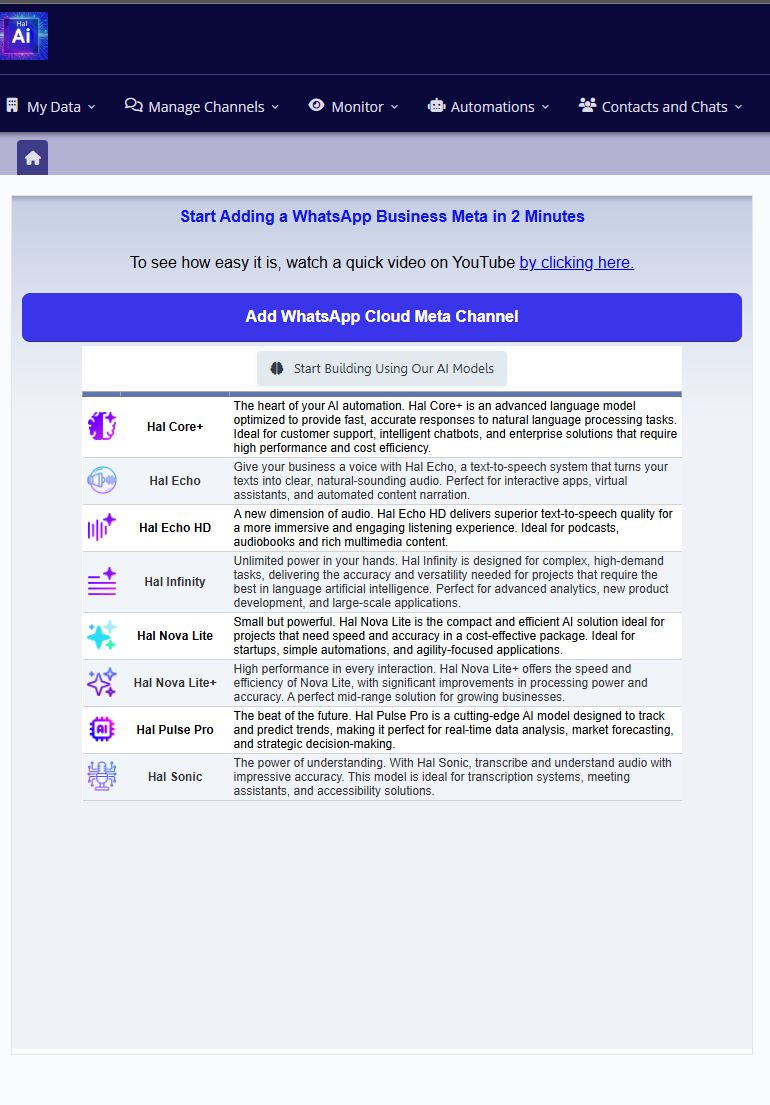
Conversation, voice, transcription and analysis don't call for the same model. The platform exposes the Hal-AI line so each agent and each routine uses what makes sense — without the manager ever having to think about infrastructure.

Hal Core+ The language core: fast, accurate answers for support, customer service and high-performance enterprise use.
Hal Infinity Complex, demanding tasks, advanced analysis and large scale.
Hal Nova Lite Compact and fast, for simple automations with strong cost-benefit.
Hal Nova Lite+ Mid-range: the speed of Nova Lite with more precision.
Hal Pulse Pro Trends, real-time analysis and market forecasting.
Hal Echo Text-to-speech with a natural voice for assistants and narrated content.
Hal Echo HD Higher-fidelity text-to-speech for immersive audio.
Hal Sonic Audio transcription and understanding with high accuracy.
Screenshot of the Hal-AI dashboard showing the Start Building Using Our AI Models table: Hal Core+, Hal Echo, Hal Echo HD, Hal Infinity, Hal Nova Lite, Hal Nova Lite+, Hal Pulse Pro and Hal Sonic, each with a description of its use alongside it.
The model selection screen in the Hal-AI dashboard.
Who builds it

A platform born inside an engineering house

Hal-AI launched in 2022 and belongs to the 2CW group — Cloud & Artificial Intelligence — with more than 35 years behind it in enterprise infrastructure and software.

2022 Hal-AI launched
+35 Years of experience in the 2CW group
8 Models in the Hal-AI line
+40 languages Supported in the published aviation case

Patent filed with the USPTO

2025 · memory framework for autonomous agents

NVIDIA Inception

Since 2024

Meta Business Partner

Official WhatsApp Cloud API

AWS Partner

Cloud infrastructure

IEEE Senior Member

Marcos Alves, founder and CEO · May 2025
Meta Business Partner AWS Partner Network NVIDIA Inception Program

Programs Hal-AI takes part in. Trademarks belong to their respective owners.

Frequently asked questions

What people usually ask about the platform

Do I have to design the service flow before launching the agent?

No. Instead of a diagram, you define the agent's personality, upload your company knowledge into the Knowledge Vault and enable the tools it may use. Choosing the action at each turn is the agent's job.

Does the agent really remember older conversations?

Yes. History is vectorized through embeddings and a background worker extracts stable facts and customer traits, with a sense of mood and time. Long-term memory is switched on or off per agent, and the Conversation Memory screen shows what is stored per channel and lets you clear it.

Can the agent query my ERP or my order system?

Yes. You register the endpoint, the authentication headers and a description, and the API becomes a tool the agent can use during the conversation. There is also support for MCP servers and an importer that reads a source's documentation, lists the endpoints and builds the tools.

Which AI model does the platform use?

The platform exposes the Hal-AI line — Core+, Infinity, Nova Lite, Nova Lite+, Pulse Pro, Echo, Echo HD and Sonic — and each agent or routine uses the model suited to the task: conversation, voice, transcription or analysis. You choose the model by its Hal-AI name, not by the infrastructure behind it.

What exactly does the patent cover?

The 2025 USPTO filing — Autonomous Agent Memory Framework Inspired by Human Cognition — covers the memory and context framework for autonomous agents inspired by human cognition: how the agent keeps short- and long-term memory, retrieves the relevant context and sustains continuity on a task. Internal implementation details are not disclosed.

Bring us a real process and we'll show you the agent running on it

Our team will talk through your operation, the systems the agent would need to query and what would make sense to automate first.